The Caterpillar's Bargain
Inside a chrysalis, a caterpillar dissolves before it flies. On natural struggle as a developmental input, the Stoic shape of responsibility, and why the load is not the obstacle to wings.
“Remember that you are an actor in a play, which the author chooses: short if short, long if long.”
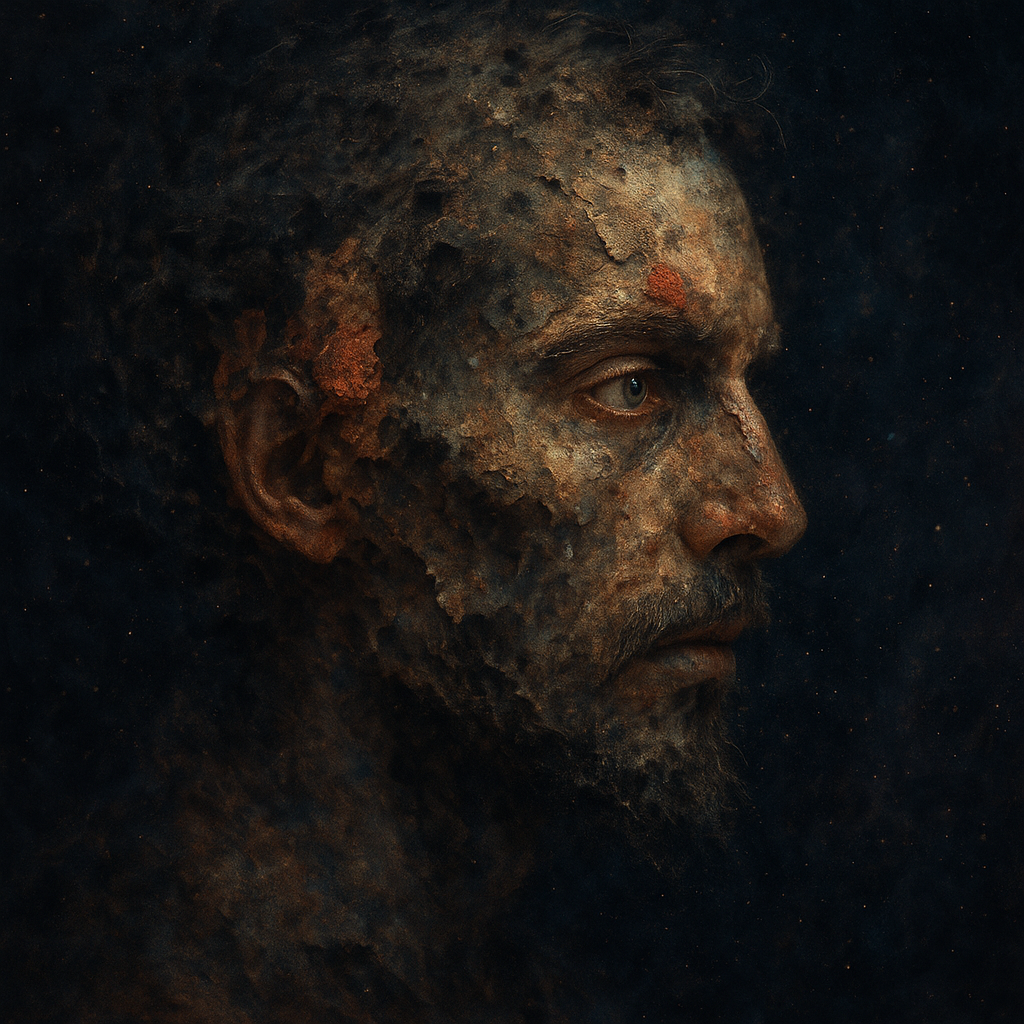
Inside a chrysalis, the caterpillar does not grow wings the way a child grows taller. It dissolves. Much of the body breaks down into a nutrient soup, and out of that soup, using clusters of cells that have been waiting dormant since the caterpillar was an embryo, the butterfly assembles itself. The creature that enters and the creature that leaves share a body the way two books share a printing press.
I have spent an oddly disproportionate amount of time thinking about caterpillars, and in particular about what happens when you try to help one become a butterfly before it is ready. Open a cocoon too early, even out of genuine kindness, and the wings may never grow strong enough to carry anything. Leave the process alone, and the struggle itself becomes part of what makes flight possible. I do not believe that lesson belongs exclusively to insects.
The famous parable, and what it gets right
You have probably heard the story: a person watches a butterfly struggle for hours to emerge from its cocoon and, moved by mercy, snips the shell open with scissors. The butterfly emerges swollen and crippled, its wings never inflating, and drags out a shortened life on the ground. The struggle, the story concludes, was not the obstacle to flight. It was the mechanism. The effort pumps fluid into the wings and strengthens the body that must carry them.
I want to handle this honestly, because I distrust easy parables, including the ones I love. Entomologists point out that the tale is often embellished; assisted emergence does not always doom the animal, and different species have different needs. Fine. But strip the anecdote down to what is structurally true and it survives. For holometabolous insects, the work of emergence is part of development rather than an accident blocking it. Resistance is not what stands between the caterpillar and its wings. Resistance is one of the materials the wings are made of.
That inversion is the whole essay. We habitually model struggle as friction, a cost subtracted from transformation. The chrysalis suggests the opposite sign. For living things, the load is a developmental input. Bone densifies under stress. Immune systems educate themselves against adversaries. Muscle is, famously, a negotiation with gravity. Remove the resistance and you do not get the same organism sooner. You get a different and lesser one.
Training makes the abstraction embarrassingly concrete. Nobody builds endurance by reading about running; the adaptation arrives around the fortieth minute, when the body would sincerely prefer to stop. Language works the same way: the week of immersion where every conversation is a small humiliation is also the week the ear finally retunes. I see it in engineering too. The junior who is handed the answer learns the answer. The junior who is handed the failing test, the stack trace, and an afternoon learns debugging, which is the thing that will still be useful when the framework changes. The discomfort was never the tax on the lesson. It was the lesson, wearing work clothes.
Marcus Aurelius and the shape of responsibility
“You have power over your mind, not outside events. Realize this, and you will find strength.”
The Stoic move is the same inversion at human scale. Marcus ruled an empire through a plague century, and the discipline he preached to himself nightly was never control but triage: some things are up to me, most things are not, and wisdom is knowing the boundary precisely enough to stop spending yourself on the wrong side of it. Struggle, in that picture, is not a malfunction of the world. It is the raw material of the only project that is ever truly ours, the quality of our own response.
Triage translates surprisingly well to an ordinary Tuesday. The inbox will never be empty, the news will never be calm, and someone will always be performing outrage for an audience. Almost none of that is up to me. What is up to me is narrower and less photogenic: whether I did the deep work before noon, whether I kept the promise I made yesterday, whether I answered the difficult message instead of archiving it. I have started writing those three down each morning, not as productivity theater but as a boundary line. Everything above the line gets my full weight. Everything below it gets acknowledged and released, the way you release a grip that was never holding anything.
What moves me about the Meditations is that it is not a book of conclusions. It is a man re-deriving the same conclusions every morning because he keeps forgetting them, which means Marcus, the most powerful person alive, spent his reign negotiating with the same comfort-seeking animal I negotiate with. The chrysalis does not ask the caterpillar whether it feels like dissolving; neither does life ask us. The dissolve is not optional. The only real choice is whether we treat it as destruction or as construction, and that choice is made in the dark, before any wings are visible.
I keep returning to him for reasons that have nothing to do with Rome. What holds me is the seriousness with which he approached choice, responsibility, discipline, and the obligation to inhabit whatever follows from a decision. Almost everyone who holds real power is tempted to treat consequence as something that happens to other people. He refused that temptation in private, for years, with no audience and no reward.
There is a hard edge here that I want to keep sharp rather than sand it down. The metaphor concerns growth through resistance, and it is not a verdict on people crushed by circumstances no creature should be asked to face. A butterfly pressed under a boot was not offered a developmental opportunity. The parable holds only where the struggle is proportional and survivable. Where it is neither, the honest response is not philosophy but help. I try to know which of the two I am looking at before I reach for the lesson.
Life as a play we keep auditioning for
Marcus borrowed from the theater more than once: the role assigned to you, the script you did not write, the duty to play your part well anyway. It is the older metaphor, and I think the caterpillar is its biological proof. Neither creature chose the arc. One crawls, one dissolves, one flies. What was ever in the creature's power was the fidelity of its performance at each stage, the crawling done fully, the dissolving not refused, the flying not squandered.
Some days, life appears to run on the same principle. We are given circumstances we did not select, we struggle through transformations we did not always choose, we make decisions on partial information, and eventually we have to inhabit the consequences of those decisions. The stages do not negotiate and the script does not ask. What remains ours is the manner of our entrance into each of them.
Maybe that is what a life is: not a single performance but a sequence of moltings, each demanding a small death before its small flight. The consequences of skipping a stage do not disappear. They wait, and they present their bill later, in a currency we usually pay with time. The play does not require us to enjoy the dissolve. It requires us not to skip it.
When to pick up the scissors
None of this settles the hardest case, which is when the struggling creature is someone you love, or someone you manage. A parent watching a child wrestle with a problem set, a mentor watching a junior flounder on a task, a lead watching an engineer sink into a bug: the scissors are right there, and using them would feel like kindness. Sometimes it is. The distinction I have learned to draw is between scaffolding and rescue. Scaffolding narrows the problem without solving it: a hint, a smaller test case, a question that reframes the stuck point. Rescue removes the struggle entirely and with it the adaptation the struggle was building.
The test, again, is embarrassingly practical. If my help leaves the other person more capable next time, it was scaffolding. If it leaves them more dependent, it was rescue wearing a kind face. I get this wrong regularly, usually in the direction of rescuing too fast, because watching someone dissolve is uncomfortable and I would rather be useful than patient. The chrysalis does not grade on comfort, though. It grades on whether wings formed, and wings form late, invisibly, and only under load.
So when I see struggle now, in myself or in anyone, I try to hold two questions at once, because both matter and neither cancels the other. First, is this friction building something, and can it be made survivable? Second, is this weight merely crushing, and can it be lifted? The wisdom, I suspect, lives almost entirely in telling those two apart. The scissors feel like mercy in both cases. In only one of them are they.